Florida made it law. Other states are paying attention.
Building departments and code enforcement offices across the country are facing the same pressure: state legislatures are setting hard permit deadlines and attaching real financial penalties for missing them. Florida is leading the way with two laws already in effect. If you work in a Florida building or code enforcement department, the clock is already running. If you work anywhere else, your state is already taking notes.
In Florida, HB 267 and SB 180 have changed the rules. One sets strict permit approval deadlines with automatic fee reductions for every day you miss them. The other requires every jurisdiction to have a formal storm recovery plan before the next hurricane hits and limits what code enforcement can do in the aftermath. Together, they are a preview of where accountability for building and code departments is heading nationally.
THE DEADLINE PROBLEM: HB 267
HB 267 took effect January 1, 2025. It gives building departments hard deadlines to approve or deny permit applications and penalizes departments for every day they run late.
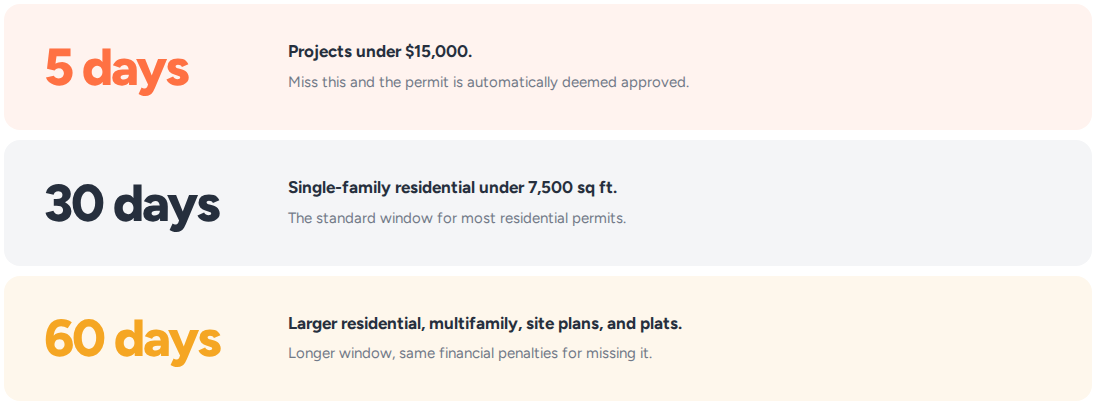
The question is not whether your department is tracking permits. It is whether your system is built to keep pace with deadlines that now carry automatic financial penalties. Miss one with no revisions requested and the department loses 10% of the permit fee for every business day it is late. If revisions were submitted and the deadline still passes, that jumps to 20% per day. Run out the clock entirely and the state treats the permit as approved with no review completed. That is not just a compliance problem. It is a budget problem.

THE STORM PROBLEM: SB 180
SB 180 took effect June 26, 2025. It creates new obligations for both building departments and code enforcement offices in hurricane-impacted areas.
For building departments, it requires a formal post-storm permitting plan before a disaster hits. That plan must cover three things: staffing protocols, expedited permit procedures, and multiple in-person service locations. Building departments also cannot raise permit or inspection fees for 180 days after a state of emergency declaration.
For code enforcement, the impact is just as significant. For one year after a storm makes landfall, local governments cannot tighten land development regulations or add new hurdles to site plan reviews. That limits the tools code officials have right when they need them most. Enforcement pressure peaks after a storm. The law caps what they can do.
After Ian, Helene, and Milton, Florida building and code departments handled thousands of simultaneous requests with skeleton crews and no unified system. SB 180 exists because that cannot happen again. But the law does not provide staffing or tools. It sets the mandate and leaves execution to you.
THE STAFFING REALITY
Both laws assume departments can move faster and handle more volume. According to the MissionSquare Research Institute's 2024 State and Local Workforce Survey, 54% of local government respondents expect the largest wave of public sector retirements to hit within the next few years, on top of staffing levels that still have not recovered to where they were before 2020.
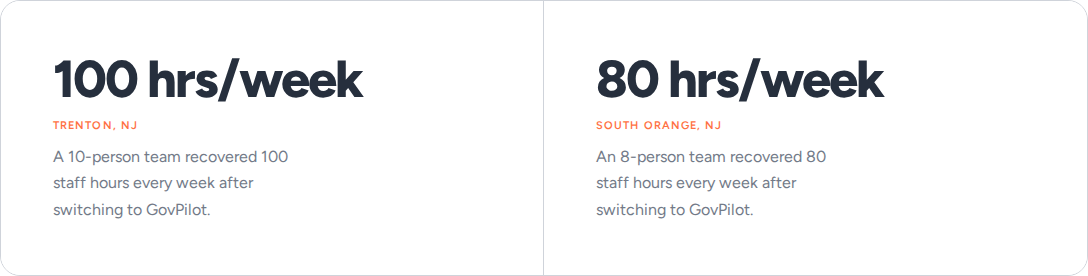
In Trenton, NJ, a 10-person inspection team recovered 100 staff hours per week after switching to GovPilot and GovInspect. South Orange, NJ did the same with a team of 8, recovering 80 hours per week. Those are not hours saved on a single project. Those are hours returned every week, permanently.
WHAT MODERN BUILDING AND CODE DEPARTMENTS LOOK LIKE
GovPilot automatically tracks every permit application against your HB 267 clock and alerts you before deadlines hit. Reviewers can look up and cite the exact ICC code section inside the platform when writing denial notices, which the law now requires for engineer- or architect-signed applications.
For code enforcement, GovPilot connects permit and violation data across departments in real time. When a storm hits and code officials need to move fast, they are not starting from scratch or coordinating across disconnected systems.
For storm recovery, GovPilot's cloud-based platform lets both building and code staff process work from any location with an internet connection. GovPilot locks fee schedules during a declared emergency so staff cannot accidentally override them. The constituent portal publishes the storm recovery guide SB 180 requires, out of the box, no configuration needed.
In the field, the GovInspect app lets inspectors and code officers issue violations, attach photos, and move to the next site without returning to the office.
THE BOTTOM LINE
Florida did not pass these laws to make your department's job harder. It passed them because permit delays and storm recovery failures have real costs for residents. But the mandate falls on building departments and code enforcement offices to execute, with the staff and systems they already have.
Departments that are ready will hit the deadlines, protect their fee revenue, and keep enforcement running when the next storm hits. Departments that are not will keep losing ground on both.
See what GovPilot looks like for your department. govpilot.com/demo

%E2%80%9D-6.png)